Thursday, March 22, 2018

Signals Using Waves

https://www.vector-eps.com/wp-content/gallery/audio-waves-and-signals-vectors/audio-waves-and-signals-design1.jpg
Summary:
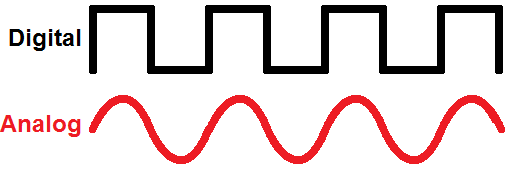
Waves come in many forms. We have things like sound waves which is a mechanical wave. Then you have something like microwaves used in your phones or light waves that are electromagnetic waves. Now that you know some examples of waves let's talk about why they are even useful. Waves first off is a mean of communication. First off the easy one when we speak we release sound waves which people interpret as us speaking. Yet that's not the only way we can use waves to our advantage. Digitalizing waves which is when you use the form of the wave and put it within ranges of numbers makes it so what you just said can be transmitted all across the world. Digital looks blocky because it is not an analogy like analog waves are. Analog waves copy the wave while digital put what it is hearing from the waves in categories of numbers to be able to relay the message.

Using Models:
In class we used a model of a slinky being the wave a person being the receiver of whatever message was being relayed a transmitter relaying the message, and an image generator writing down what the message is. These pieces were to show what is like to relay a message using analog and digital waves.  First we had digtal where there was two options one stroke was 1 and two strokes was 0. The receiver would be blind and would have to say what they felt. We gained mostly 100% accuracy with this system showing that digital is easy to read. Then we did analog where we would have the receiver not blind and looking at the wave. The would have to guess what number the transmitter was trying to relay between 20-60 in increments of 10. This was very difficult to reach 100% accuracy showing that analog has more of a range is harder to interpret.

Patterns:
Waves may seem complicated and you must be wondering how can anyone ever get any information from them. Well you just need to think of a wave especially when its digital as a pattern. In digital the pattern is a certain pattern of 1's and 0's creating the wave that you originally produced. For analog its much larger ranges and an analogy of the pattern. You could say that analog is like tracing an image while digital is making a sketch of the image. Analog is trying to replicate the original wave or pattern while digital is trying to get a general idea and put it in a more simple form.

Saturday, March 10, 2018

Digital Vs Analog

https://cdn.sparkfun.com/assets/learn_tutorials/2/1/5/analog_vs_digital.png
Summary: Analog Vs Digital. Which side are you on? Well before you make your choice let me explain a little more in depth what each is. An analog signal is a analogy of the wave its interpreting. For example when a analog technology tracks sound waves it gives a good analogy of what the sound wave is interpreting making them look smooth like you can see up above. Then you have digital. Digital is a when you have certain number ranges and they transfer the original wave for example sound and use the ranges they have in numbers to get a good representation of what they wave represents. This is bad however because waves are smoothed and curved meaning when you do these ranges you miss out on some information. Yet digital is good in the sense that is is transferable for example you can send music to someone across the country because its just a bunch of numbers.

S&EP: Conducting Investigation:
You may hear all this stuff and digital vs analog but the best way to really see if you truly do miss out on some of the quality and sound when it comes to sound waves it by doing an investigation. We had a student record himself playing a song with his flute. We listened to the quality and sound of that. They we listened to the same student on the same instrument with the same song play the same thing and just but that investigation we determined as a class that when its recorded sound loses its quality and fullness. Digital gets rid of some of the sound that you will hear when it is done live.

XCC: Energy and Matter:
There is a lot to know about sound and most you must be asked the question what medium does sound travel through best; liquid,gas,or solid. If you guessed gas you are correct and ill tell you why. You see sound is a vibration of molecules which means when the closer the molecules are the more efficiently they can pass the energy that the vibration produces between them. So that is why a solid which had its molecules more dense and connected is able to carry sound so well because the molecules can transfer the vibration from one to another very efficiently and quickly while with things like liquids and gases the molecules are more spread out making the vibrations harder to pass.

Wednesday, March 7, 2018

Waves Mastery Quest Regrade Blog Post


Question 4:
  
The actual answer is the second container because unlike the other two containers the molecules are compact and close to each other. Looking at it now you can see the first container represents water because its not really connected or bound to each other and more so fall around each other and the last container is a gas because they are spread far apart. In water since the molecules are not bound to each other like in a solid they don't carry a vibration as well as a solid aka the second container would and same with the air because it is very far spread out making the vibration of the molecule harder to carry. So therefore a the second container carries sound the most efficiently.

Question 5:
Amplitude is the measure of how much_________the wave is carrying
The actual answer is frequency because it amplitude will only pay attention to how high or low the wave is. Frequency is how high or low the pitch is. This will be shown with how high or low the wave is so amplitude measures that distance from the middle line meaning that unlike what I had answered which was energy which is not the case at all because even though there is energy in waves that doesn't mean amplitude measures that energy.

Question 6:
Cell Phones use______ waves.
Cell Phones use microwaves. You see cell phones use receive microwaves from the nearby phone mast. Then your phone send back microwaves. The short burst of waves or the microwaves can carry a ton of information extremely quickly. Think of texting you basically get  texts back instantaneously after they are sent and when do your texts send slower? Thats went you are furthest from a phone mast. A reason why you would use microwaves instead of something like gamma ray is because microwaves don't have enough energy to break chemical bonds meaning it cannot be harmful to things like your skin.
Sources:
https://www.technologyreview.com/s/423871/cell-phones-microwaves-and-the-human-health-threat/
https://www.peep.ac.uk/content/1310.0.html

Question 13:
_____ carry the greatest amount of energy.
Gamma rays carry the most amount of energy because they are the the highest on the electromagnetic spectrum. Gamma rays are also radioactive or have radiation making them much more powerful then something like a microwave. It is so powerful that it can break your skin and damage your cells. The higher the energy the more damage it causes to chemical bonds. So that is how you know they carry the most energy.

Question 25:
In a transverse wave,particles move?

As you can see a transverse wave moves back and forth for example this transversal wave in the photo is going to the right and once it hits a surface it will reflect and go to the left proving that transverse goes back and forth.

Question 26:
The action of a wave bouncing off a surface is called______?
It is called a reflection which makes sense because think of an echo which is a reflection of your voice. When your voice echoes back it doesn't alter but instead repeat what you had originally said. What I had originally chosen was diffraction which is a word to actually describe how light spreads out after crossing a narrow space or an edge. We know this is clearly wrong becasue we are referring to sound waves not light.

Question 29:
A ________ is the  distance between a point on one wave and the identical  point   of the next wave.
I had originally had answered frequency but frequency is not about the distance but more so how many waves pass in a certain about of time. Wavelength is measured from either trough to trough or crest to crest which is the bottom of the wave (trough) and the top of the wave (crest). When it says an identical point it means the nexts wave top or nexts waves bottom making it so wavelength is the answer to this question.

Friday, March 2, 2018

Sound

https://www.school-for-champions.com/science/images/sound_transverse.gif
Summary:
Everyone (expect for the deaf) have heard sound. It comes in the form of music, dogs barking, us talking, and many other examples. Well let me explain what sound is all about. First of all sound is just a vibration of molecules. Thats why its possible for a high pitch to shatter glass
=https://thumbs.gfycat.com/SelfassuredHalfElectriceel-size_restricted.gif
The reason that trick works is because the vibrations of the sound wave are so intense they break the glass into pieces. A sound wave is the wave like pattern sound makes. Let me teach you a bit about what sound waves look like and how to read them first. If you see really high waves especially high in the sense of amplitude which as you can see from the image if the height from the middle line to the top of the wave then you have a loud sound on your hands. If the amplitude is shorter than its a softer sound. As for high and low pitches( pitches are how high or low a note is) you will see that high notes have more waves per second which is called a high frequency. Frequency is how many complete waves there are in a second. As for low notes there are less waves per second. Refer to the picture below for more clarification.

http://www.jeron.je/anglia/learn/sec/science/light/waves23.gif


S&EP: Conducting Investigations: 
We conducted many investigations to be able to properly conclude that indeed sound is a vibration of molecules. The first experiment we had a tuning fork. We would strike the tuning fork with a pencil and after you hit it you can lightly touch one of the prongs and feel the vibration of the metal. Another example we had a pingpong ball that hung from the table. We struck the tuning fork with the pencil and then we put the tuning fork next to the ping pong ball. The ping pong ball would then hit the tuning fork and continually bounce off the fork due to the vibrations. Then last but not least we would strike the tuning fork with a pencil and place it in a tub full of water. Once the fork made contact with the water the water splashed around due to the vibrations. Therefore in conclusion sound is a vibration of molecules.

XCC:Cause and Effect:
The vibration that is sound doesn't just stop at vibration, I mean how would you hear it. That's why sound has a power that cause and effect reveals. For example the echo. Have you ever yelled into a cave "Hello" and you heard your voice call back to you. That echo is produced by your voice or more so your voices vibrations hitting a surface like a wall and bouncing back at you. That's why an echo has a delay because it has to take the time to hit something and then com back to you. So the cause of an echo is your voice and the effect is of course the echo!


Wednesday, February 14, 2018

Roller Coaster Project Blog


Image result for roller coaster

Summary:
Have you ever been to amusement park?  Well have you ever wanted to bring the amusement park to you? The Roller Coaster Project did just that. We learned the key aspects of a rollercoaster like acceleration at the right times things that give thrill factors like hills, turns, and loops. It is all there when designing a roller coaster. Durning this project I was tested with the consistant changes in the build, working with the different aspects of the challenge and of course gravity and the physics behind an actual rollercoaster.
What problems did you encounter while you were working on this piece? How did you solve them?:
Some problems we faced were that since our material was not as secure as something like metal it would tilt and mess up between days. We would have to rework and retape things a lot because it would dry of be knocked out of place. How we fixed this was just a lot of testing slight tweaks and reworks from what we already knew about a working roller coaster.
What does this piece reveal about you as a learner?:
This piece taught me I am good when I can see whats going on. I don't have to be the one to drop the marble but if I see the movement of it around our track I can learn to understand its patterns better that way rather than just in its number forms. Seeing consistent patterns with something you just learn the basics of how things function better.
In what ways did your work meet the standards for this assignment? In what ways did it not meet those standards? :
Our project had the basics. It had the complete Design Brief and of course this sutori. The build of the roller coaster was quite good as well but I think that we could have done better in some other departments. For example we should have labelled the build for the different aspects in it. We also could have worked harder on making the theme more clear and easier to detect. Overall I think we did quite well but if we had more time we could really push this to the next level.
One thing I would like to improve upon is ... :
I really wish we could have labelled the pieces of the coaster according to the questions. I really think I would feel more confident with the work if we had gotten this piece done. Also finishing the design of the the snake like build would have been nice too but was not as important to me.

Saturday, February 10, 2018

Roller Coaster Build

http://www.dailyrepublic.com/files/2016/01/roller-coaster-tour-2-1024x697.jpg
Summary: Have you ever built a roller coaster? Chances are no but most of us have made our own race tracks or maybe roller coaster out of materials we have at home. Now a childhood pass time is connected to science and more specifically the science of motion. Roller Coaster are all powered by motion. It would be no fun it the carts never moved. What makes things move? Well lets start with some types of energy. Kinetic Energy is the energy of motion. You would think a roller coaster only needs Kinetic Energy but that is not the cause. Energy has to come from somewhere which is were we get Potential Energy. So when your cart is hanging  right over a great slope your cart has a lot of potential for energy if it is pushed forward. Potential Energy is converted into Kinetic Energy letting you have fun on a roller coaster.

S&EP: Using Models:
Since I can't make a life size rollercoaster to ride around in lets scale it down. What do you need to make a small roller coaster? Well you could use simple materials such a a marble as your cart, tubing, tape, and something like dowels and cardboard to help secure it. Now the tubing can't just be placed in any form if you have your track flat on the ground and then expect your marble to get over a giant hill it won't work. But why? Well for something to have any energy it must either have Kinetic Energy or Potential Energy. If the marble is just sitting on the track with no force being applied to it it will not move. This is due to Newtons law. An object in motion will stay in motion. An object not in motion will not move. You see to make your track work you need to create a situation where you keep speed until you want the marble to stop.

XCC: Structure and Function:
The first step to making your mini coaster work is by looking at examples of what has already been done. Roller coaster usually start of a position really high. This is to gain that Potential Energy that is all important. Then once you release your marble you will see if you created a hill it will speed down it. Now how do we continue this track of speed. This is where all the twist and turn come in. If you want the marble to keep its movement you can make something like a hill. It will go a bit slower on the way up but on the way up the amount of energy it takes to go us will be put back into going back down. You could use this new energy to make a loop or sharp turn. Slowly the marble will come to a stop once it has lost all the Kinetic Energy in it. This is ok all rides need to end at some point but depending on the structure of your build and how you lay it out and make sure you keep that kinetic energy going you can keep your coaster moving for a while

Friday, February 2, 2018

Potential Vs Kintetic

Image result for bow and arrowImage result for arrow in air

Summary: Kinetic Vs Potential. Which one of these images do you think is Kinetic? Which one is Potential. To figure this out you need so definitions. Kinetic Energy is the Energy of Motion. Kinetic Energy is things that move like the arrow flying through the air. Potential Energy is the Energy of Possible Energy. Would you believe me if I told you that an arrow that has not been released yet like in the left image also has energy. That arrow has the potential to have a lot of energy on release. That every don't just appear when you let go but it is stored up to be used while you pull back the string of the bow. Potential Energy is converted into Kinetic when you let go of the string or when motion is added.

S&EP:  Conducting Investigation:
 This week we used Gizmo to test Potential Energy. What was observed from the interactive is that the higher the ball or any object goes up on shelves or at different equal heights the ball or object will have a potential energy at about a perfect ratio. If on the first self the potential energy is 1 then you could expect that when you get to shelf 2 it will be 2 and so on a so forth. If you are working with even things since gravity is not going to suddenly change on Earth you can expect predictability.

XCC: Cause and Effect:
Newton basically invented this idea so it's unavoidable to avoid this great man when it comes to physics. Everyone knows the classic. Every action has an equal and opposite reaction. To help you understand this better let me explain with the trampoline example. When you jump on a trampoline you always expect to be landed back up for every time you go down, but why? This comes from your understanding or this law of physics. You came down on the trampoline with lets say a bounce of 5 meters per second. Based on what Newton has proven you know that once you hit the trampoline the trampoline will take that force and use it to bounce you all the way back up. That's Cause and Effect baby!