Friday, November 17, 2017

FLUXX Project Blog

http://www.thinkgeek.com/images/products/zoom/hrtg_fluxx.jpg
Summary: Fluxx. The competitive game where with every turn the rules change and the end goal differs. Players have cards that can either hurt them like creepers and some unwanted new rules. Or card that will aid them on the game. Fluxx games all are basically the same. The only thing that differs is the goals and the keepers. Keepers are your key to winning a Fluxx game. On the goal cards you need to find two keepers that match up. Throughout rounds of ever changing rules you do your best to be the first to win. You never know when someone may change the goal and the quest starts over again. Some of the Action cards even mess you up. Like rotate hands or stealing others Keepers. This wonderful game was recreated by my class and I. We picked Science related topics and based the entire themes of the game on that. So welcome to the world of Fluxx!


Backward Looking: In what ways do you think you could improve?
     I believe our cards would have looked really amazing in color. I feel it would have added more of a lively feel to the entire game. Also I feel our lamination could have been improved. Since I had to redo it on some of the cards the ink that transferred from the card to the sheet made it harder to read the card when put back on. If you look at the example up above they are all colorful and bright. If ours had that it would make it look for like the real deal!

Inward Looking:How do you feel about this piece of work? What parts of it do you particularly like? Dislike? Why? What did/do you enjoy about this piece or work?:
    I really liked  how when we were creating the game we got a good look at first off how this game works. When it came down to actually playing since I had been working on the mechanics for so long it was really simple. Also I think it was a good lesson on how things connect just like the Cross Cutting Concepts. When making goals it took a deeper understanding of the topic and the value of the goals depended on how in depth you went with your ideas.

Outward Looking: If you were the teacher, what comments would you make about this piece?:
     If I were a teacher I would comment on the printing of our cards. I would not comment on how it is not in color though because some people just can't print in color. I would more so suggest that if we are using a darker color that you make sure all your images and works are dark enough and contrast enough with the white background. You want people to be able to see your keepers/images.

Forward Looking: What would you like to spend more time on in school?:
     If I had more time on this project I would have made sure that the card stock was more fun. For example if we had planned the dates better we could have organized a time to use the color card stock and apply them to different types of cards. It would have made our deck pop a little more and possible improved the general aesthetic. Just to make the cards more desirable would be the main goal.



Thursday, November 9, 2017

FLUXX

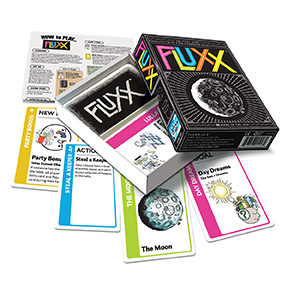
http://www.looneylabs.com/sites/default/files/Fluxx5.0_3D-Contents_sm.jpg
Summary: Fluxx is a game were every round the rules and goals for winning change up. It is a game where you have to see connection between different keepers. This game is a great reflection of Cross Cutting concepts. Keeper goals always have to do with connection two related keepers together to win the game. We have been presented with the challenge of  making a Fluxx game related to a science topic. For example my game is about Astronomy so one of the goals could be collect the Big and Little Dipper.


S&EP: Asking Questions Defining Problems: We mostly  were asking questions and defining problems when making our goals. We of course wanted to make our goals interesting and not too much of a stretch. This did require mixing things around and replacing keepers. It took further investigating even into greek mythology. We say how important or unimportant a keeper was and changed or kept it accordingly. It wasn't just a two second choice but you needed to select your keepers with care so they could fit. Just like a puzzle piece. All the pieces must have a purpose and fit or it just won't work.

XCC: Patterns: Have you ever looked up at the night sky and traced the stars? Well other people had that exact same hobby. You have just made a constellation. Constellations are like the connect the dots of the stars. This makes interesting designs such as the Big Dipper, and Orion's belt. Constellations which ties into my Fluxx game tend to have a background. For example the constellation Hercules connects with the Greek Mythological hero Hercules. Galileo was one of the first astronomers and he looked into the night sky like you may and discovered many things. Like the rings of saturn and Callisto. So next time you are staring at the stars know that their is an entire world up there!

Friday, November 3, 2017

Pingo-uck Project Blog

https://drive.google.com/open?id=1TpYStXkReZYrPkGshVuxuReDVsSnhHWD
Summary:
       Met the Pingo-uck. The Pingo-uck is a bird that has pieces from flamingos, flies, peacocks, and parrots. Lets start from head to toe. The head has umbrella like feathers to prevent its body from getting wet. Its eyes are multipfactited to be able to see all around its surroundings.  Then its body is covered in color on the one side to attract mates and the other side grey like rocks to camouflage. It has a wide tail that acts like a flotation device in the water. Then depending on the gender its feet will be webbed for catching fish ( female) or clawed for catching deer mice ( male). Evolution may sound random but this project is supposed to simulate how organisms are so well thought through. For example all the things I listed out to you right now have a purpose and could be added to a future organism that could like a Pingo-uck through Natural Selection. If your dreams of an organism don;t include magic or something that doesn't already exist your ideas may become a reality.

Backward Looking: In what ways have you gotten better at this kind of work?:
This project was definitely a creative curve for me. First just the creation of such a unique creature was something I haven't done before. Especially making a creature fit for an environment that wasn't this overpowered beast. Making something you could actually see in a part of the world is a really special thing and it takes a different level of creativity. Another things this project pushed me creatively to do was draw. Once we knew how this organism would act in the environment I had to use what I imagined its day to day life being like onto paper. Putting the image in your brain onto paper is bringing a world to life. The Pingo-uck was mashing science and imagination and it was awesome!!!

Inward Looking:What was especially satisfying to you about either the process or the finished product? : In the end I found it really satisfying that out of all the groups we were really the only one to really use a lot of hand drawn imagery. Other people just got images from the internet to show in general what they were trying to describe. With hand draw images we could be very exact on what we wanted the view to feel and think when they looked at the image. We could control the image it left in their head and didn't leave them guessing on what we were intending.

Outward Looking: What was especially satisfying to you about either the process or the finished product?: If I were a teacher commenting on our work I would comment on two things. One since the images added a sort of charm to our presentation some slides could have really used more than one image. Since it is somewhat a leverage for us we could have definitely made sure there was more of that to really give a closer and clearer idea of the Pingo-uck.Plus we could have really used practice on our presentation. At some points it became rather repetitive and we could have possibly done without some lines.

Forward Looking: What's one goal you would like to set for yourself for next time?: 
Next time I do a project I really hope to bring justice to my creativity. My presentation was fair and I think the slides looked really good. Next time I will make sure the script is more solid and that it matches with the amount of real effort we put in the project. It didn't quite reflect how much thought went into the animal. My goal will to be show my projects worth and create an engaging presentation.

Wednesday, October 25, 2017

Design an Organism

https://mackenziesdragonsnest.files.wordpress.com/2012/10/delvila-1861317.jpg
Summary:
          You know and love all the classic mystical creatures. If you look closely at each of these mystical creatures you can see pieces of things we actually have alive right now. For example for a unicorn it would be the horse and for the dragon a reptile or bat. It is interesting to think its could be possible to make a unicorn like horse through evolution or a giant dragon like reptile. Organisms you think of can be anything for plausible to insane but you will usually see pieces of the real world organisms within those images.

S&EP: Asking Questions Defining Problems:
       The creature I have been working is called the Pingo-Uck. It is as a female an aquatic bird that is colorful on one side and camouflage on the other. We added some crazy things to this creature but when you draw if back they all have good reason and purpose. For example it has big bug like multifaceted eyes. This is not just to look cool but to give it high perception of its surroundings. Then it has an umbrella like feathered structure atop its head to be able to protect it from the consistent rain. Every detail we had to ask why it was important and why the species would even evolve to have it. The best formula to determine the purpose of each piece of a organism that would be able to exist but not be this over powered beast is quite simple. First ask is this possible. This eliminates any crazy thoughts like magic or teleportation. next ask if its useful. Like rainbow hair that goes all the way down to the floor what would the purpose of that be. if it is just for show and would not assist in any way such as mating of survival then remove it.

XCC: Scale, Proportion, and Quantity: When creating an organism you need to know when enough is enough. You need to sometimes put practicality above good looks or cool features. For example if you had a whale would it be practical to give it bright shiny skin? Well of course not. Also think of things like size. if you were to have a real life dragon as something like a house pet you wouldn't want to make it skyscraper big. It must fit its environment. That is the point of selective traits to fit nicely with the environment and increase survival.Just always keep a rule of thumb that whatever it is it must be able to survive in its environment.

Thursday, October 19, 2017

Cladogram

https://www.philpoteducation.com/pluginfile.php/1160/mod_book/chapter/1064/5.1.4d-full.jpg
Summary: The Cladogram. The perfect tool to organize common ancestry and progression of traits. For example lets look at the image above. Starting with sharks what the cladogram tells us is that it came earlier then all the animals after it going to the right and that it has a vertebrae.  Now lets skip to the crocodiles . What the cladogram shows us about the crocodile is that it came after everything to the left of the crocodile. Also it had  a vertebrae, a bony skeleton, four limbs, amniotic egg, and eggs with shells. Those were some tips on how to read a cladogram.

S&EP: Using Data: Now you may be wondering how to craft this cladogram. Well you must start with information you know. For example by looking at the animals skeleton you can tell many different things. You can see how many fingers the animal has, has four legs, if its skeleton is made of bones,and  if it has a vertebrae. With these pieces you can already tell where it can generally be placed on the time line. If it has for example four limbs it cant be anywhere below the mark of four limbs because that trait was not developed yet. If you want to get more exact then if the organism is still alive check out other features. Does it have hair? Does it have an amniotic egg? These can also place it further up on this cladogram. Then last of all how did you even get this fossil. From a sedimentary rock most likely. Sediment rocks hold the secrets to when this animal was alive.  Now you have a beautiful cladogram to show you everything you need to know.

XCC: Cause and Effect: Evolution is just a trickle effect. One organism breeds with another and after that if changes the course of that family lines history. Lets say that there is a species of white rabbits and they only ever breed with white rabbits. Then there is no chance for there to ever be brown rabbits. Until one day they do cross breed with a brown rabbit because the white rabbits fur was no longer blending in.  Then now the rabbits will and can pass down traits of brown rabbits. The effect of this new mix is that the white rabbits won;t be as common because first of all now they brown rabbits have started to cross breed with them and also the brown rabbits have better camouflage.That is how evolution changes so quickly and why we have so much diversity. One breeding can change everything.

Saturday, October 14, 2017

Proof of Evolution

https://i.ytimg.com/vi/5ej-HAXuspk/hqdefault.jpg
 Summary: People can say about anything and you can believe it or not. Like I could say that the sky is purple or that the Earth is flat. Yet those statements mean nothing without anything to back it up. That's why when you hear about Evolution the first question you should ask is How do you know? Let's look into just a few examples of how Evolution can be proved. The fossil record; this is when you look at the fossils within layer of sediment rocks and see how the bones of animals can be connected and how they gradually change. Fossils can strongly support that animals evolve over time and how they have a common ancestor. Next we can look at embryology. This is when you look at early development of different mammals and see how similar they look in their fetus shape. It is near impossible to tell the difference between a early pig and a human. This can show that we are possibly related since we look basically the same in the beginning.

S&EP: Using Models: We created a giant poster to organize somewhat of a fossil record. We had the Adventuran fossils all the back from the Cambrian. First we organized them by oldest to newest. Then we can observe how they gradually changed over time.For example over time they split off into two different variations. The grey heads and the white heads all came from one common ancestor. Back in the Cambrian there was only one type of organism. Then it split off after evolution and gradual changes. This activity was supposed to be an example of how a fossil record works and how you can see the relationship between organisms that seem very different.

XCC: Stability and Change: Evolution. The gradual change of organisms. The theory saying that all animals have one singular common ancestor. It may seem random and just a chance change and for the most part it kinda is. How could Evolution have such order when it comes from disorder. Well it actually is somewhat predictable. There is a 50% chance of getting a trait one of the parents have. Its impossible for two brown furred cats to have a white furred cat. Then Natural Selection of course. Something Darwin suggested while observing his finches. His finches were all different across the different island. Natural Selection provided the finches different becks so they could eat what they needed. Natural Selection dwindles down the best in a population for better or for worst.

Saturday, October 7, 2017

Natural Selection

http://images.slideplayer.com/26/8702244/slides/slide_1.jpg
Summary: Natural Selection also known as Survival of the Fittest. When you hear the phrase Survival of the fittest you probably think of the strongest,fastest,the greatest. Well that is not quite the case. Survival of the Fittest is when the organisms most fit for the environment will live long enough to reproduce. This is why in the photo above there are more long necked giraffes when short necked. Since the long necked giraffes can eat the green better than the short necked giraffes they can eat and live a long life. Natural Selection is nature's way of picking the best traits in a population.


S&EP: Analyzing Data: We did a simulation of the different finches that Darwin observed. Each one having a different beak. These beaks each had a skill in eating different types of foods. Once all the "finches"of each beak type got together and got the average of how much they eat of each type of food we determined two things. One we figured out of all the finches which ones were most skilled in eating certain foods. The "Scissor Beaked Finches" were the most successful , being skilled in three different food types. Then we looked at what each group was eating. For example the "Toothpick Beaked Finches" were not skilled at eating beans. With a large chart of averages you could easily compare the different skills of each bird. The importance of making these comparisons is to see how nature's reason for variety. If all the finches ate one food then there would be competition for this one thing. Yet when there is a variety they all usually have one thing they will eat each. This means that the playing field is even and Natural Selection will do the selecting.

XCC: Cause and Effect: The passing of traits may feel very random. Yet it had simple process that has quite a bit of variables. First you start of we need a male and female of the species. Yet before reproduction happens you must question how these two organisms got to the place they are in. First they needed to be able to support themselves through collecting food and fending of predators. Next they would have to be able to attract a mate. Like with crickets how they will do a song to attract mates. If there traits are desirable then everything is set. Then these two organisms now are set to reproduce. The variables that it takes there is Natural Selection. Pretty interesting right?